The artificial intelligence landscape has a new landmark. On July 16, 2026. Chinese startup Moonshot AI unveiled Kimi K3.
A model that has instantly reshaped conversations about the global AI hierarchy. Described by some as a “Sputnik moment” K3 is not merely an incremental update; it represents a fundamental shift in the open-weight AI paradigm and a direct challenge to the established order of American tech giants.
The Colossus: A New Scale of Open-Source Intelligence
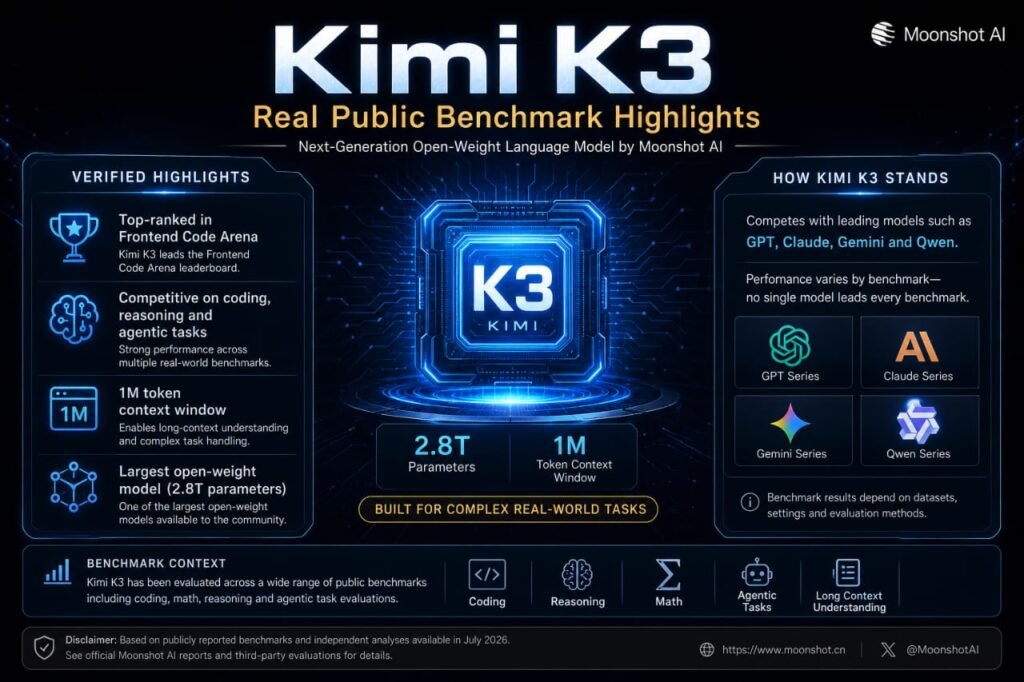
At the heart of Kimi K3 is its sheer scale. With 2.8 trillion parameters, it is the world’s first open-weight model in the three-trillion-parameter class . To put this in perspective, it surpasses other prominent open-source models like DeepSeek V4 Pro (1.6 trillion parameters) and even Chinese tech giant Baidu’s own Wenxin 5.0 (2.4 trillion parameters) .
This scale is paired with a massive one-million-token context window, giving the model a “working memory” capable of digesting the equivalent of entire books or thousands of lines of code in a single session . This is not a model designed for simple question-answering. It is built for long-horizon coding, complex reasoning, and knowledge-intensive work that requires sustained attention and minimal human supervision .
K3’s architecture is built on several proprietary innovations, including Kimi Delta Attention (KDA), Attention Residuals (AttnRes), and a Mixture of Experts (MoE) framework that activates 16 out of 896 experts for each task . These advancements, alongside new optimizers like MoonClip and KimiLinearTension, have been crucial in training a model of this magnitude efficiently . The company has stated that these innovations allow the model to be approximately 2.5 times more efficient than its predecessor, Kimi K2 .
Benchmark Bravado and Real-World Performance
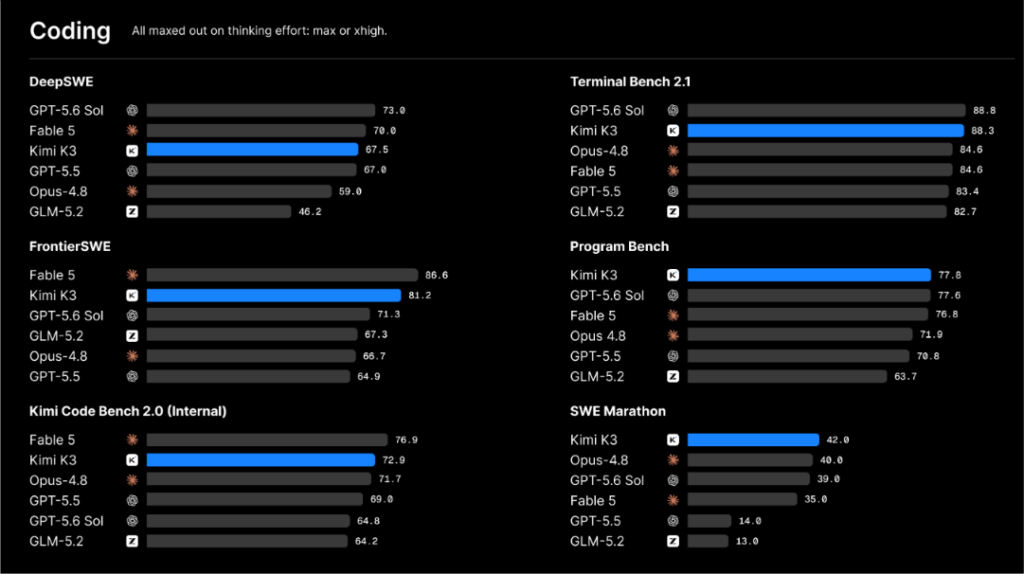
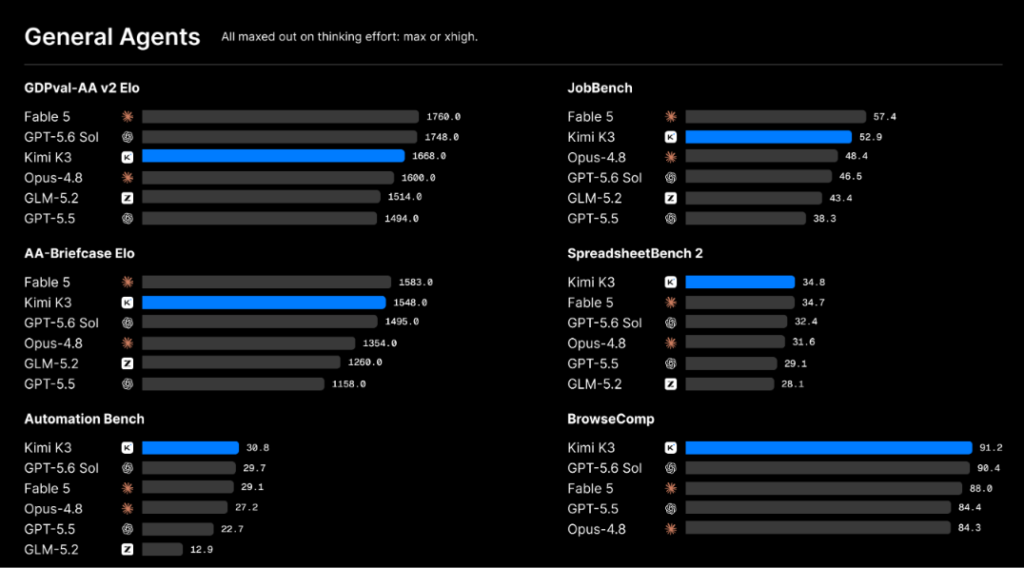
The official narrative is one of impressive convergence. Moonshot AI and independent evaluators place Kimi K3 in the global top three, behind only Anthropic’s Claude Fable 5 and OpenAI’s GPT-5.6 Sol . In the Artificial Analysis Intelligence Index, K3 scored a 57, outperforming models like Claude Opus 4.8 . Furthermore, in the Arena.AI leaderboard, it secured first place in six out of seven categories, including branding, data analytics, and content creation, while also topping the charts in front-end web interface engineering .
Chip Design: K3 autonomously ran for 48 hours, using open-source tools to design and verify a functional 4mm² chip with 1.46 million standard cells .
Scientific Research: It replicated a complex astrophysics study (the I-Love-Q relations) in two hours—a task that would typically take an experienced researcher one to two weeks .
Video Editing: It created a high-density short video from 56 source clips, handling scene selection, cut matching and audio processing in a fraction of the time a professional editor would require.
However, the user experience on the ground is more nuanced. While the benchmark scores are undeniably impressive, early adopter feedback has been mixed . Some users have reported that the model is “overly verbose” and slower than competitors with some programming tasks failing to run correctly . Community feedback suggests that while the model is a “big step forward” it sometimes struggles with simpler tasks and can be slow, consuming tokens rapidly . Moonshot AI itself has acknowledged that K3 falls short of the top US models in user experience noting the model’s sensitivity to previous thinking and a tendency to overreach in simple situations.
The “Sputnik Moment” Geopolitics
The launch of Kimi K3 is charged with geopolitical significance. It comes at a moment when the US government is increasingly viewing advanced AI as critical national infrastructure, as seen by the temporary restrictions placed on Anthropic’s models . Chinese companies, despite strict US export controls on advanced AI chips, are demonstrating an ability to build frontier models.
For researchers and developers, the fact that K3 is open-weight is monumental. Unlike the closed proprietary models of OpenAI and Anthropic, K3’s weights will be publicly available allowing for modification and research . This could democratize access to top-tier AI, allowing global institutions and smaller companies to work with a system that rivals the best. As one researcher told Nature, there has been a significant push for open-weight models and K3, as the largest ever, is a “particularly exciting” development.
The Pricing Dilemma: A Calculated Gamble
Perhaps the most revealing aspect of the Kimi K3 launch is its pricing strategy. which signals a new phase in the AI arms race. While Chinese models have historically competed on price. Moonshot AI has set K3’s API at a premium, charging $15 per million output tokens. This makes it the first Chinese model to price itself on par with US flagship systems.
This move is a direct statement. By pricing K3 near the level of Claude Opus 4.8 and GPT-5.6 Sol, Moonshot AI is asserting that its technology has reached a level of parity that justifies a premium . While it is still more affordable than the absolute top-tier ($15 for K3 vs. $50 for Fable 5 and $30 for GPT-5.6 Sol), it is a massive leap from the $0.80 charged by its domestic rivals like DeepSeek V4-Pro.
According to Moran Stanly Report:
A Morgan Stanley report noted that this could have a far-reaching positive impact on China’s AI market, steering it away from a destructive price war and toward more sustainable business models . However, this strategy places K3 in a precarious position. It is priced at more than three times the cost of Zhipu AI’s GLM-5.2, a domestic competitor that many developers use as a “cost-effective alternative for coding” . This puts the onus on K3 to prove that its superior performance justifies the significantly higher cost—a proposition that remains unproven . The high price also clashes with the Chinese market’s deep-rooted expectation of affordability, creating a “sweet burden” for the company as it navigates the commercial landscape.
Benchmarks Report: